Robotic Collaboration: Humans + Machines Safely Working Together Picture This

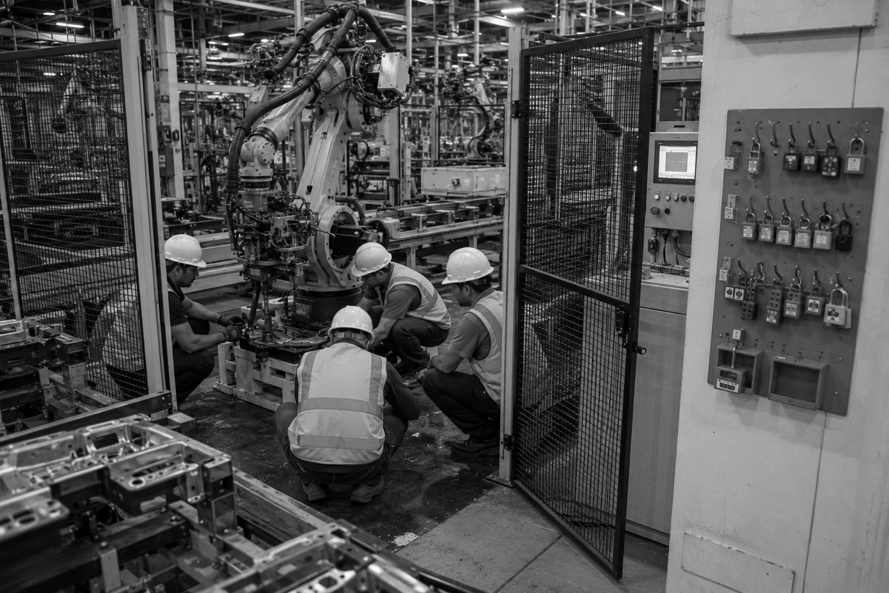
This image shows the interior of an automotive parts manufacturing plant where an assembly line has stopped mid-production. Four workers in hard hats and safety vests have entered an open robotic station to clear what appears to be a sensor fault — tools in hand, crouching near the robot’s base, focused on the malfunction. The robot’s safety cage door is open and unsecured. No lockout device is visible on any of the energy control points around the station. A lockout/tagout station mounted on the nearby wall has not been accessed. One worker is positioned directly inside the robot’s reach envelope. The control panel at the edge of the station shows the system in a paused state — not a de-energized one.
Everything in this image looks like a routine response to a routine problem. The line stopped. Workers entered to fix it. This is how it is done here — quickly, without locking out, because production needs to restart. That assumption — that a paused machine is a safe machine — is the exact condition that kills. A robot in a paused state retains stored energy, active programming, and the ability to restart the instant a signal changes. No worker should ever enter a robotic work envelope without full energy isolation confirmed and locked out. Not to clear a fault. Not to adjust a sensor. Not for any reason. The few seconds it takes to apply a lock are the only seconds that stand between a routine task and an irreversible one.