


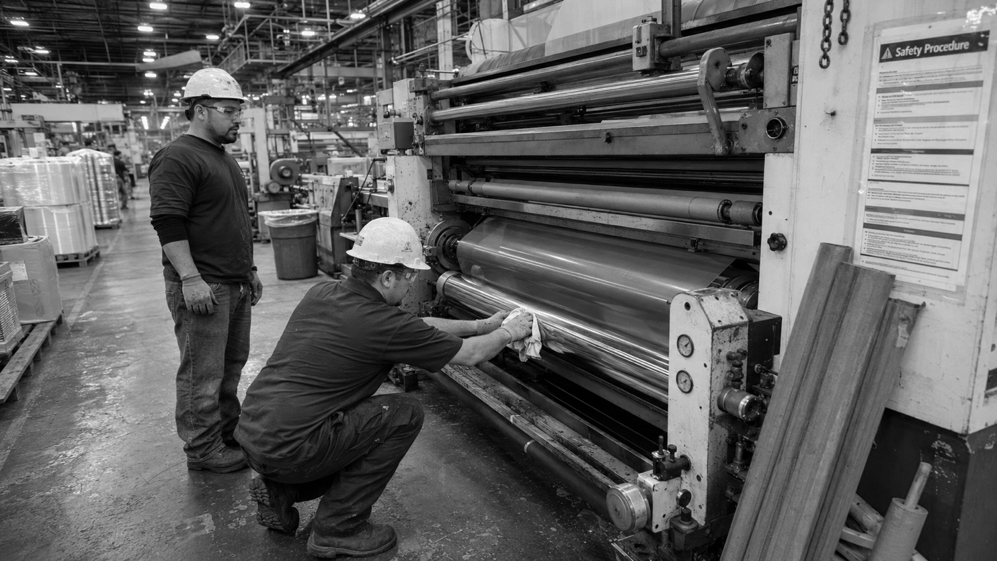
This image shows a manufacturing facility where a production line is running at full speed. A worker who has been performing a supervisory role is now crouching beside a large industrial coater machine, attempting to clean a chrome roller while the machine continues to operate. No lockout has been applied. No guarding is in place between the worker's hands and the moving parts. A supervisor nearby glances over but says nothing. On the wall behind the machine, a laminated safety procedure is posted — partially obscured by a stack of materials leaning against it.
What is about to happen in this image is entirely predictable — and that is exactly the point. The moment a worker transitions from one task to a new one, the hazard profile changes completely. A person who was observing a machine moments ago is now directly exposed to its moving parts, with none of the controls that task requires. No one called a stop. No one asked what the new task would demand. No one checked whether the machine needed to be de-energized first. A task change without a hazard reassessment is not a shortcut — it is an uncontrolled exposure. Before performing any new job step, stop and assess what that step requires, what could go wrong, and what controls must be in place before work begins.


