Fireworks Aren't Just Fun & Games
When Canada Day celebrations roll around, it feels like the whole country lights up. I remember a few years ago in my hometown of Vancouver, a group of neighbours decided to turn their cul-de-sac into a mini fireworks festival. Amid the laughter and cheers, I noticed my cousin Julia squinting against a sudden gust of wind that redirected sparks toward her. She ended up with a small burn on her forearm— nothing life-threatening, thankfully—but it was a sharp reminder that under those festive colours lie real hazards.
Let’s talk about what happens behind the scenes. Data from the Canadian Hospitals Injury Reporting and Prevention Program (CHIRPP) shows that burns account for over 60 percent of fireworks-related injuries in our hospitals, and the head is the most frequently injured body part (nearly 40 percent), followed by eye injuries at about 20 percent. (Government of Canada) Even more striking: 42.3 percent of these patients are just 10 to 14 years old, and fully 77 percent are male—teenagers and young adults who often underestimate the power in their hands. (Government of Canada)
Those injuries really spike around our big holidays. CHIRPP data shows that nearly a third of injuries happen in the days surrounding Victoria Day (May 16–24) and Canada Day (June 29–July 3), and there’s another bump around Halloween too—when backyard ghost shows meet handheld fireworks. (Government of Canada) You might think, “Well, those are oddball spikes,” but they underscore the same point every time: people lighting fireworks at home, often on uneven ground or too close to buildings and dry grass, without a clear safety zone.
So, how do we turn those hazard-laden moments into worry-free memories? First, consider attending a municipal or professional display whenever you can. Cities like Calgary, Ottawa, and Halifax invest in trained pyrotechnicians who handle all the complex calculations—launch angles, fallout zones, wind-speed buffers—so you get the spectacle without the risk. It’s the safest, most reliable option.
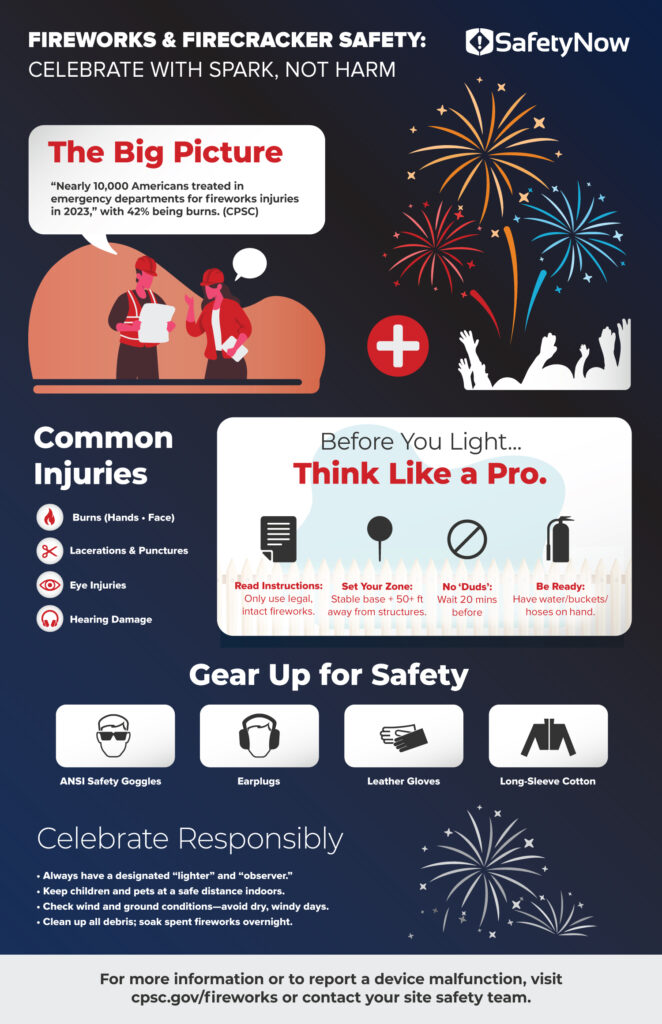
If you do choose to light consumer fireworks yourself, treat the whole exercise like a small-scale construction project. You wouldn’t build a deck without reading the instructions and gathering the right tools—so don’t light fireworks without the same preparation. Always purchase from provincially licensed retailers, never from unregulated street stalls, and check each device to make sure fuses are intact and packaging is undamaged.
Imagine your backyard transformed into a “launch pad.” Clear out that propane barbecue cover, fold up the lawn chairs, and sweep away leaves or stray twigs. Place each firework on a flat, stable surface—an empty flowerpot or a block of sand works wonders to stop rockets from veering into unintended paths. Then, mark off a spectator zone at least 15 metres away from ground-based devices and 30 metres from aerial shells.
When you’re ready to light the fuse, use a long-stem lighter or a punk—never hold a match or cigarette lighter close to the spark. Strike once, then step back immediately. I’ll never forget chatting with a fire captain in Toronto who recounted a call where a family tried relighting a “dud” just five minutes after it fizzled out— and lost two fingers as a result. Let any misfire sit undisturbed for at least 20 minutes, then submerge it in water overnight before disposal. It’s a simple precaution that prevents lifelong regret.
Protective gear isn’t overkill—it’s your frontline defence. ANSI-rated, CSA-certified safety goggles are essential to shield against hot embers and metal fragments. Earplugs or earmuffs can reduce noise levels that routinely exceed 140 decibels—louder than a jet taking off. Thick leather-palm gloves guard your hands, and long-sleeved, non-synthetic clothing prevents stray sparks from sizzling through to your skin.
And let’s not forget our four-legged and feathered family members. Dogs, cats—and even backyard chickens—can bolt in terror when fireworks explode. Before your first launch, bring pets indoors to a quiet room with familiar blankets and perhaps some soft music to drown out the bangs. It spares them anxiety and keeps them from darting into roads or over fences.
Weather matters, too. In regions like British Columbia and Alberta, dry springs can turn your lawn into tinder. A single spark carried by a light breeze can ignite a grass fire in seconds. If Environment Canada issues a fire‐danger warning or gusts are above 20 km/h, rethink your backyard show or scale it way back.
Let’s pause for a quick check-in:
Does everyone know who the “lancer” (the person lighting) and the “lookout” (the person watching for hazards) are?
Is the water supply—hose, buckets, even a fire extinguisher—within arm’s reach?
Have you swept and soaked spent shells and debris at the end of the night?
These aren’t formal “rules”; they’re simple habits that keep celebrations joyful rather than chaotic.
Now, imagine this scenario: It’s dusk in Regina on Canada Day. You’ve set up your display, neighbours are gathered, and someone hands 12-year-old Sophie a sparkler. Instead of the usual “Point it away and hold it by the end,” you’ve already briefed everyone: only adults handle any fireworks, sparklers included (they burn hotter than you’d guess—up to 1 600 °C!). You’ve stashed all the kids safely inside, and Sophie gets a glow stick instead. No trips to the emergency room for a finger burn—just smiles and swirling colours.
Before we wrap up, let’s talk first aid. For minor burns, running cool (not ice-cold) water over the area for 10–15 minutes and covering it with a sterile, non-adhesive dressing often does the trick. But if there’s blistering, white leathery patches, or signs of infection—swelling, redness, fever—seek medical attention right away. For cuts or punctures, direct pressure with a clean cloth, followed by gentle cleaning and a sterile dressing, is your go-to; deep wounds or persistent bleeding also warrant professional care.
Ultimately, it’s about building a culture of safety. Gather your group for a brief huddle before the first spark flies. Clearly assign roles—who lights, who watches, who keeps an eye on the pet room—and make sure everyone knows the location of your emergency water source. At the end of the night, take five extra minutes to walk the launch area with a flashlight, soak any leftover fuses or casings, and pack up responsibly.
Fireworks capture our imaginations—they’re a testament to creativity, colour, and celebration. But that magic only holds when we treat each device with respect. By learning from Canadian data, embracing straightforward precautions, and looking out for one another, we guarantee that every “oooh” and “aaah” ends in laughter, not sirens.
Here’s to lighting the fuse on joy—and keeping everyone safe from coast to coast. Have a spectacular, injury-free Canada Day!
Download report to access the Safety Talk.