


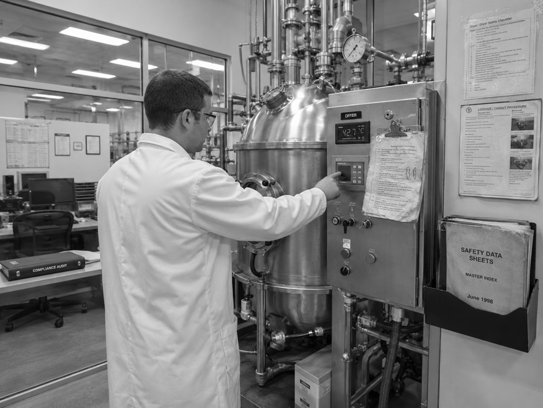
This image shows the interior of a pharmaceutical chemical manufacturing facility where a worker is operating drying equipment connected to a pressure vessel as part of a production run for a specialty chemical product. The worker is following the steps on a printed procedure sheet clipped to the equipment — but the sheet has not been updated since the product formulation changed. A safety data sheet folder sits in a wall-mounted holder nearby, the SDS inside still showing the original chemical properties without the combustibility data that was identified but never formally documented. A compliance audit report from six months earlier sits in a binder on a supervisor's desk in the adjacent office, its recommendations unread by most of the crew. The pressure vessel is operating outside its safe temperature range — a deviation that has no alarm assigned to it because the consequences of deviation were never evaluated.
Working with materials whose hazard profiles are incomplete, outdated, or unknown removes every layer of protection that stands between a worker and a catastrophic event. When a substance can combust, decompose, or react under conditions that have never been identified, there is no safe temperature limit to enforce, no alarm to trigger, and no procedure to follow when something begins to go wrong. In any operation involving repurposed, recycled, or specialty chemical materials, workers must insist that every substance they handle has a current, accurate SDS before work begins. Temperature limits must be documented and enforced. Audit findings must be acted on — not filed. And any time a product formulation changes, the procedures, SDS, and hazard assessments must be updated before the next production run starts. A material whose hazards are unknown is not a manageable substance — it is an uncontrolled one.


